As a technically driven business, Kudos Blends seeks to understand how the baking powders affect, and is influenced by, every aspect of the baking process.
Viscosity is an important consideration for us because the right viscosity is crucial for a batter or dough to “hold on” to carbon dioxide produced by the baking powder reaction. The level of aeration will also affect the viscosity of a batter or dough.
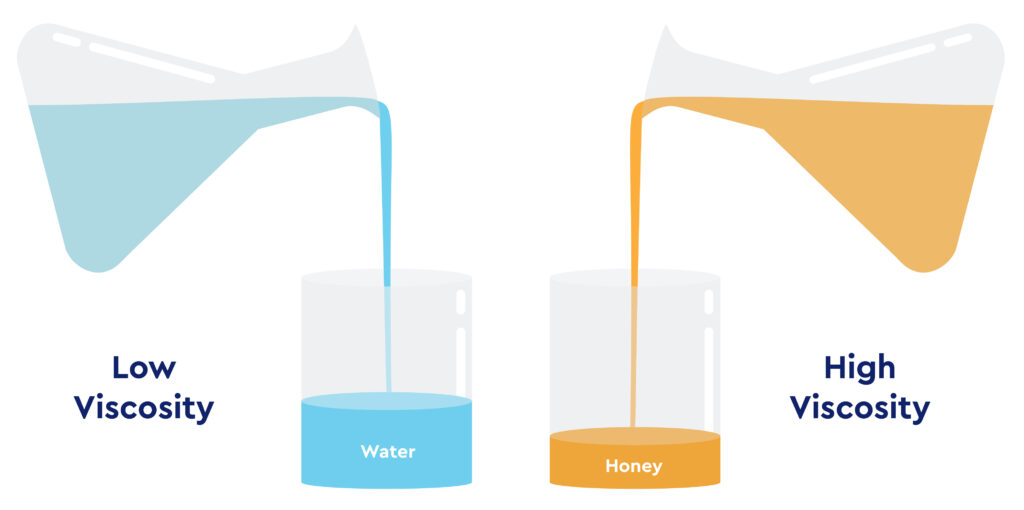
The viscosity of a material is defined as its resistance to flow. This resistance is caused by internal friction, which is the force that opposes the movement of adjacent layers within the material as they slide past one another. Fluids with a high viscosity have high internal friction, while those with low viscosity have lower internal friction and flow more easily. For bakers and industrial manufacturers, the viscosity of a batter is a significant factor when considering both processability and the quality of the final product.
For processability, an understanding of viscosity is crucial for determining optimal production plant settings, such as the force required to pump batter through pipes. The correct viscosity ensures uniform incorporation of air into a batter and prevents separation of ingredients during the holding phase. This uniformity ensures that each deposit from a mixture is as identical as possible, and a consistent product is achieved.
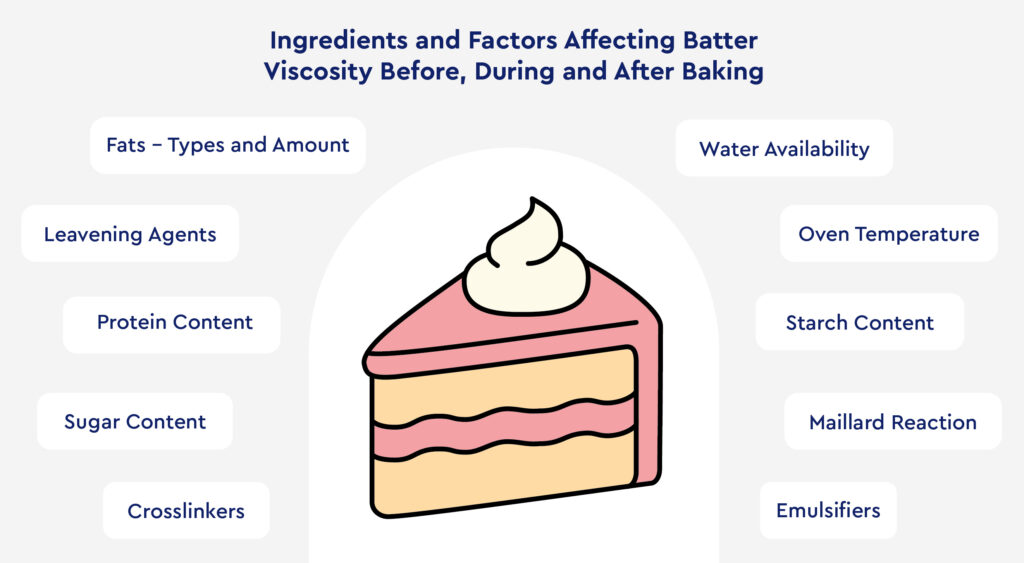
The baking process transforms a batter or dough into a set structure. This is driven by several processes and reactions, including starch gelatinisation, protein network formation, the Maillard reaction, and the baking powder reaction. The types and proportions of ingredients in the batter or dough play a key role in controlling the viscosity throughout baking and in the final product.
When considering baking powder, for optimal volume and texture, the timing of gas release must align with the batter’s viscosity. If too much gas is released while the batter is still very fluid, the bubbles will coalesce, forming large air pockets that are prone to collapse after baking. Conversely, if most gas is released too late, after the batter becomes too thick or partially set, the bubbles cannot expand or distribute evenly, leading to a dense crumb and cracking.
The Rapid Visco Analyser
As the world’s leading manufacturer of technically driven baking powders and leavening agents, Kudos Blends is dedicated to thoroughly understanding the interactions between our baking powders and the systems in which they are used. As part of the 2025 laboratory upgrade, we invested in new state-of-the-art equipment, including the Rapid Visco Analyser (RVA).
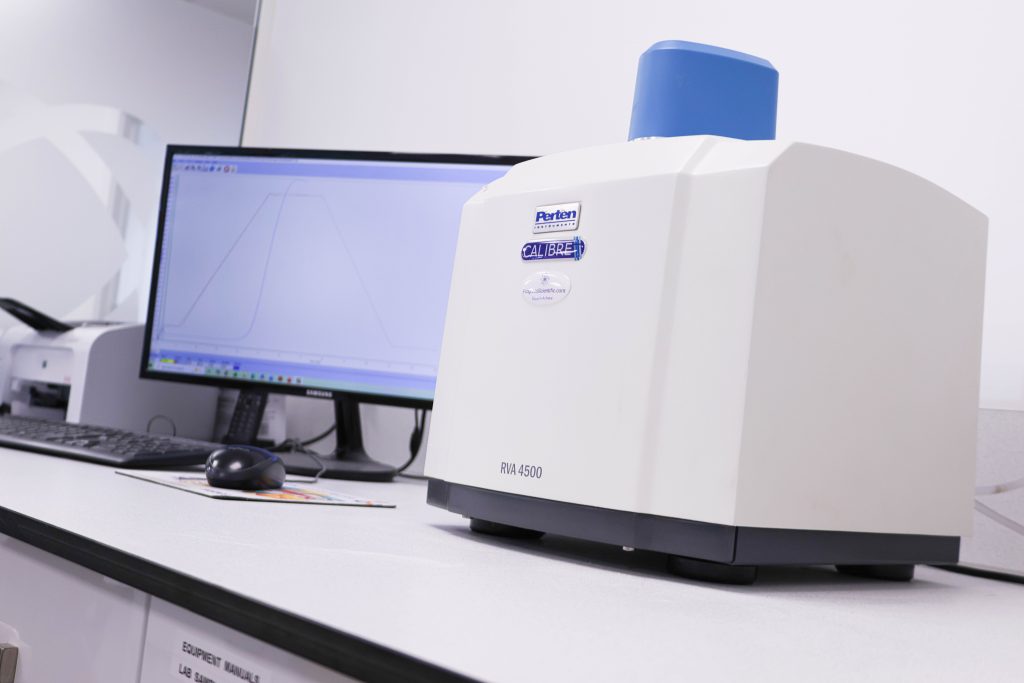
The RVA is an industry-standard tool used to measure the pasting properties of starch. It is a viscometer designed to perform temperature ramps and produce a curve that illustrates how a substance’s viscosity changes over time as the temperature varies. This enables us to understand what is happening inside a cake as it bakes and allows us to compare it to the rate of reaction of our baking powders.
Bakery Viscosity Profile
Starch-containing materials, such as cake batters, exhibit a characteristic viscosity profile during baking. As the batter’s temperature increases, the starch granules in the flour absorb water and swell until they rupture, releasing their contents. This causes a peak that is followed by a temporary decrease in viscosity, called breakdown, which occurs as the swollen starch granules rupture and the internal structure temporarily weakens under heat and mechanical shear. As the starch gel structure sets, the viscosity increases again, stabilising at its final viscosity.
The viscosity values observed at different points in the profile, along with the time and temperature needed to reach them, are affected by the amount of available water and the starch’s capacity to form a network of swollen starch granules, leached amylose molecules, and gluten proteins. This is influenced by the type of flour, the amount of water in the recipe, and interactions with other ingredients.
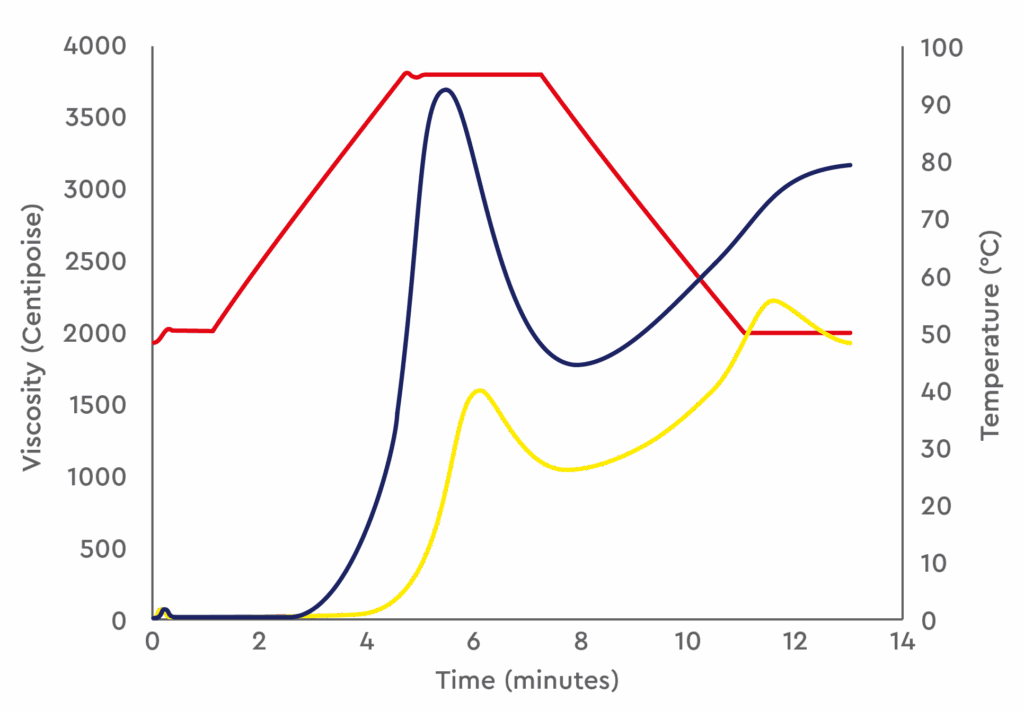
The viscosity in centipoise (cP) of the pancake batter is in blue and the viscosity of the Madeira cake batter is in yellow. The temperature is in red.
Above is an example illustrating the differences in viscosity profiles of different batter recipes. The viscometer provides a quantifiable measure of how ingredients affect the texture of baked goods by revealing differences in thickness, stability, and aeration that influence the final product’s structure and mouthfeel.
The pancake batter contains a higher proportion of flour and water and less sugar, leaving more free water available for starch granule swelling. This results in a higher peak viscosity and allows the starch to form a viscous gel as it cools. Starch gelatinisation also occurs at a lower temperature, 75 °C, compared to 90 °C in Madeira cake. In addition, the lower protein and sugar content of the pancake batter provides less structural stability, leading to a greater breakdown during heating.
Based on this, the ideal baking powder for pancakes is heat-driven. This minimises gas release during mixing, when the batter has very low viscosity and gas would easily escape. Instead, sufficient gas is released upon contact with the hot plate before the pancake structure sets.
In contrast, Madeira cake batter has lower water and higher sugar content, which limits starch swelling and delays the peak viscosity. The higher fat and egg content stabilises the structure, reducing breakdown following the peak. During cooling, the complex interactions of starch, protein, sugar, and fat produce a second peak followed by a slight decrease in viscosity. The lower final viscosity indicates a weaker, less rigid gel network, allowing the Madeira cake to remain soft and tender, while a higher final viscosity reflects a stronger, more cohesive network that provides the pancake with its chewy, elastic texture.
To reflect the slow and moderate change in viscosity in the Madeira cake, a slow-acting baking powder, such as PELL™ Restrain, or, an acidulant from the OPUS™ SALP replacer range, in combination with sodium bicarbonate, would be ideal.
Kudos Blends is committed to continually increasing knowledge of the chemistry behind baking. Viscometry is a powerful tool to bridge our understanding between the chemistry of our blends and the results seen in the test bakery. Through a combination of analysing the rate of reaction of our blends and understanding the viscosity profile of a recipe, we can determine how to achieve the desired volume, texture and crumb structure of your baked goods.
Interested in Learning More?
To learn how RVA analysis can optimise your bakery formulations, contact our technical team.