Background to Shelf-Life
Shelf-life is an important factor for any product, influencing decision-making for both supplier and customer. How long in advance a product can be made before dispatch, the distance a product can travel to the customer and the rate of product intake by the customer are all decisions influenced by shelf-life.
Every baking powder has a shelf-life intrinsic to its components and is altered by the conditions that the baking powder is exposed to.
Usually, shelf-life is measured by storing a product in typical conditions and testing at regular intervals to ensure that the functionality of the product is within expected tolerances. This is a baking powder’s functional shelf-life and represents how long a baking powder will perform as intended. This is different from a food-safe shelf-life, where a product is no longer suitable for consumption. Once the product is no longer within those tolerances, the shelf life of the product has passed.
This can be a lengthy process and could require a large amount of material for testing, especially for some products which may have a shelf-life of many years.
Arrhenius Equation and Accelerated Shelf-Life
Functional shelf-life of a product decreases exponentially with increases in temperature and humidity, which is why it is crucial to keep products in cool and dry conditions. Ultimately, a baking powder at a higher temperature will degrade faster over time than the same baking powder stored at a lower temperature.
This can be tested with shelf-life trials of the same product at different temperatures, which is called accelerated shelf-life.
An accelerated shelf-life trial consists of multiple small test samples of the same product under constant temperature, where the initial bulk sample is tested before the trial. At regular intervals, a sample is removed from those constant conditions and tested to our internal specifications.
The interaction that is being tracked is the gas release that occurs when the leavening acid and bicarbonate in the baking powder reacts, releasing water and gas. These reaction products can then also contribute to further degradation of the baking powder.
The results of the test for each sample are plotted against time (typically days) and tracked during the trial. By tracking the trial, it is possible to test a sample of the material on the day that the product degrades beyond of expected tolerances.

The Arrhenius equation links temperature and the
activation energy of a reaction to determine the rate.
The relationship between different shelf-life trials (accelerated and real-time) can be explored with the Arrhenius equation, a tool used across the branches of chemistry for its link between temperature and rate of reaction.
With some manipulation of the equation, the Arrhenius equation can be converted into a form appropriate for linear graphs. The length of time it took for the material to drop out of specification for each trial can be inserted into this form to obtain an Arrhenius plot.
The equation of the linear trendline of that Arrhenius plot can then be used to give shelf-life estimates for any temperature that is required. The shelf-life of the baking powder at different stages of the logistics process can then be estimated at the warehouse, shipping and bakery stages. This process also allows us to account for more extreme climates where the baking powder may be under increased stress.
Application of Accelerated Shelf-Life
It has been an ongoing project at Kudos Blends to use accelerated shelf-life trials and the Arrhenius equation to obtain shelf-life estimates of products. This has proved successful, with multiple products having shelf-life estimates derived that are consistent with real-time functional shelf-life trials we have conducted.
We conduct this process on a variety of baking powders across our range, as well as test new products and ingredients in development. A minimum of three accelerated trials at different temperatures is required for a product to be mapped accurately.
A simplified example of Arrhenius mapping will be explored on one of our baking powder products. To start, accelerated shelf-life data was gathered at three different temperatures: 35°C, 40°C, and 45°C. These were chosen to minimise the trial duration without compromising on the accuracy of the data.
On the graph below, these degradations have been presented as average linear degradations and displayed alongside real-time shelf-life data for completeness.
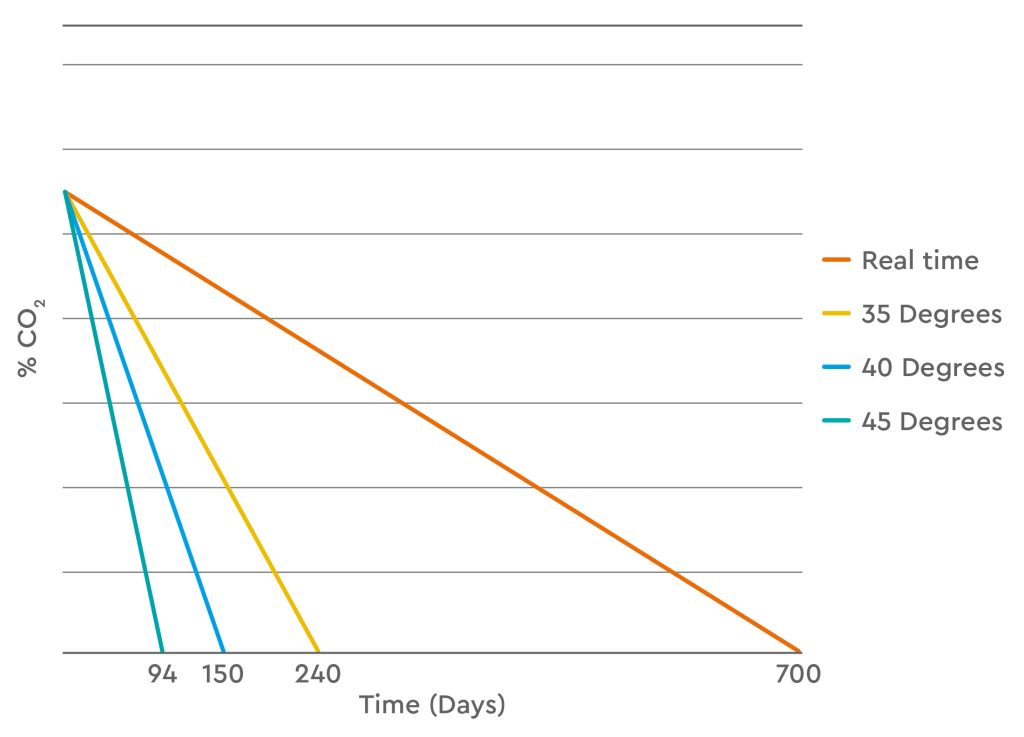
Typical degradations of a baking powder at different temperatures.
The duration at which the baking powder fell out of specification in each trial was determined and the natural logarithm of these values was plotted linearly against the inverse of the temperature of the trials. This gives an Arrhenius plot for the baking powder, displayed below. A positive linear trend is displayed, and the equation of this trend can be derived.
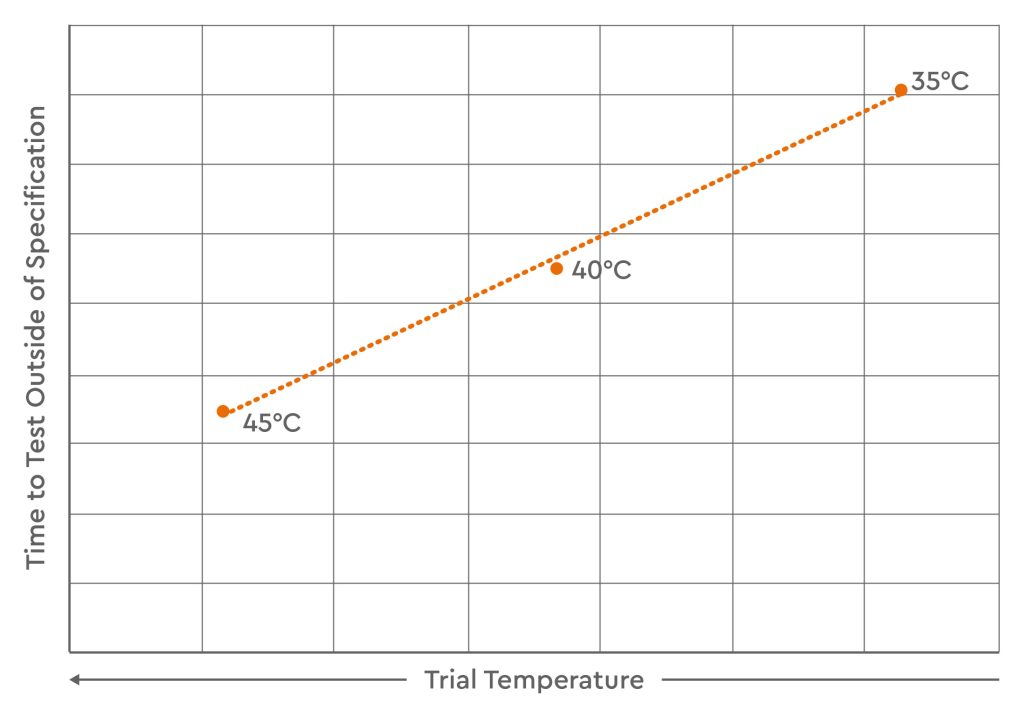
Arrhenius plot of a baking powder, plotting the results
of three individual accelerated shelf-life trials.
With the equation of the trendline, the gradient and intercept can be inserted into the adapted linear form of the Arrhenius equation. Additionally, the temperature at which the desired shelf-life estimate is required is also entered into the equation.
This full calculation will give a shelf-life estimate in days, based on the Arrhenius plot data.
For the worked example product, this gave a shelf-life estimate of almost 2 years at 15°C. This is consistent with real-time shelf-life data for this product and took significantly less time to gather. For this product, it was a matter of weeks rather than years to obtain a result. With the capacity to run a wide range of trials and the equipment capacity to test multiple temperatures at once, the time required to gather the data sets is minimised.
This supports new product development by enabling faster time to market and reducing waste product from real-time studies. It helps to identify ingredient interactions, helping us refine our product formulations. Predicting long-term stability ensures we maintain consistent product quality through accurate modelling. While we have proven the technique works in principle for multiple types of baking powders, we are still in a data-gathering phase for many of our products. This is a delicate method, with many nuances in setting up the trials and interpreting the data to achieve an understandable result.
If you are interested in learning more about accelerated shelf-life and how it can assist the development of your novel baking powder products, contact our Technical team.